
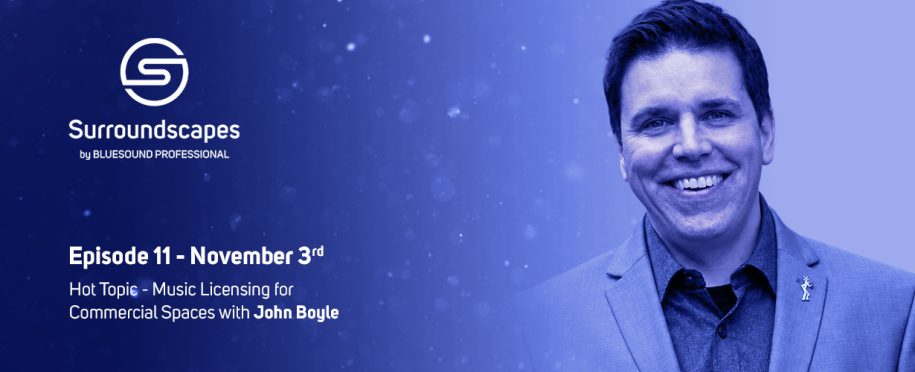
Graeme Harrison, VP and General Manager at Bluesound Professional, speaks to John Boyle, Founder of musicforbusinessfinder.com in Episode 11, Season 8 of the SurroundScapes Podcast.
In the latest episode of Bluesound Professional’s SurroundScapes podcast, host Graeme Harrison welcomes John Boyle, Founder of musicforbusinessfinder.com, to discuss commercial music licensing, choosing the right business music service and how technology is reshaping in-store experiences.
John’s career has centered around digital marketing, beginning in small startups before moving into larger technology and media companies such as T-Mobile, Expedia, GoDaddy and most recently, MoodMedia. Drawing on this experience, he recognized an opportunity to help small businesses navigate the complexities of licensing music for commercial use. In late 2025, John launched musicforbusinessfinder.com, which he describes as “Expedia for business music, helping small businesses find the best provider possible.”
Making Business Music Simpler
“One thing I found so difficult was that there was no independent place where a small business owner could quickly compare pricing, features and how the different providers work, all in one place,” John explains. The resulting platform allows businesses to compare commercial music providers, including Soundtrack, Jukeboxy and SoundMachine, helping them find a suitable solution. “From my experience, small business owners just want to set it and forget it,” John adds. “It’s hard enough running a business without having to worry about the music.”
The comparison tool covers pricing, hardware compatibility, playlist importing and multi-zone capabilities. Each provider is presented through a simple overview of its key features, advantages and limitations, with more detailed comparisons for those with specific requirements. “The goal is to provide a quick overview for those who want to make a decision quickly, but also give people the opportunity to explore the services in much more detail,” says John.
Understanding Music Licensing
The platform has since expanded to include resources on commercial music licensing, helping businesses navigate the often-complex requirements. A new licensing checker helps businesses identify the licences they may need based on their specific activities, whether that’s background music, karaoke, DJ sets or live performances.
Users simply select their business type, location and intended music usage before receiving personalized recommendations for commercial background music services and performing rights organisation (PRO) licences, with relevant links and the option to email their results.
For Graeme, educating business owners about commercially licensed music services is equally important. “If I could do one thing in educating customers, it would be getting people away from residential music services that aren’t licensed for commercial use and towards commercial music services,” he argues. “Firstly, it makes it legal. Secondly, it pays musicians more because they’re being compensated for the commercial use of their content. And thirdly, business music services offer a lot of features that residential services don’t have, making them a better tool for most businesses.”
The conversation also addresses the real-world consequences of playing unlicensed music in commercial environments. “These performance rights organizations do police this pretty actively,” warns John. “The fines are real and they’re significant. There have been examples where companies go out of business.”
To help businesses understand these risks, musicforbusinessfinder.com features a dedicated fines page documenting licensing disputes and financial penalties, including cases where businesses believed their existing music services provided sufficient coverage.
What Makes a Good Business Music Service?
For John, a good music service needs an extensive music catalogue, dependable performance, responsive technical support and the flexibility to grow with a business. “If I’ve got one coffee shop and things are going great, and I’m going to open three more, I’m going to need my music provider to expand with me. I don’t want to have to unplug this service and find a new one.”
Graeme agrees, highlighting playlist synchronization, automated scheduling, in-store messaging and multi-zone control. “Being able to synchronize playlists with a commercially licensed stream means you can have the flexibility of music curation while remaining compliant.
Music’s Influence on Customer Experience
Beyond licensing and functionality, the conversation explores music’s ability to evoke emotions and create lasting connections with customers. “Music touches us in ways that very little else can,” reflects Graeme.
John recalls how hearing Mr. Brightside by The Killers in a restaurant made the experience particularly memorable. “If you have a great experience and hear a song you love, the next time you hear that song, you’ll think, ‘That restaurant was great. I can’t wait to get back there.’”
Both highlight how music, good acoustics, sound quality and appropriate volume levels create a welcoming atmosphere. As businesses seek to draw customers back into physical spaces, Graeme highlights a crucial question: “Businesses are asking ‘what is the exact mood I want to achieve here, and how does music play into that?’”
John adds that combining music with visual and other sensory elements can make visiting a store more engaging than online alternatives.
The Future of Business Music
Looking ahead, John expects AI to transform both music services and content creation. “AI is changing everything, from how businesses are creating products to how customers are consuming and finding them,” he predicts. “I expect to see providers offering new features faster, as well as more startups entering the music space.”
This could include lower-cost services offering AI-generated music as an alternative to commercially licensed tracks. However, Graeme raises concerns about “elevator music 2.0”, where AI-generated tracks imitate familiar artists.
John agrees that these services may appeal to cost-conscious businesses but questions their long-term appeal. “I think the question will be retention,” he suggests. With employees listening to music throughout the day, quality and variety remain essential.
As musicforbusinessfinder.com continues to grow, John hopes to expand into AV hardware, digital signage, business TV and karaoke services. “How do we help a small business improve and navigate their entire in-store experience and help them sell more, and create a great place not only for their customers, but for the business owner and their staff?” he asks. “How can we make a great experience for everybody in the store?”
With its free tools and licensing resources, musicforbusinessfinder.com can support AV integrators advising customers on commercial music solutions. Recognising this value, Bluesound Professional plans to feature the platform as a resource on its website.
Listen to Episode 11, Season 8 of the SurroundScapes podcast with John Boyle here.
Follow every episode of the SurroundScapes podcast and dive deeper into the world of commercial AV at surroundscapes.bluesoundprofessional.com.