
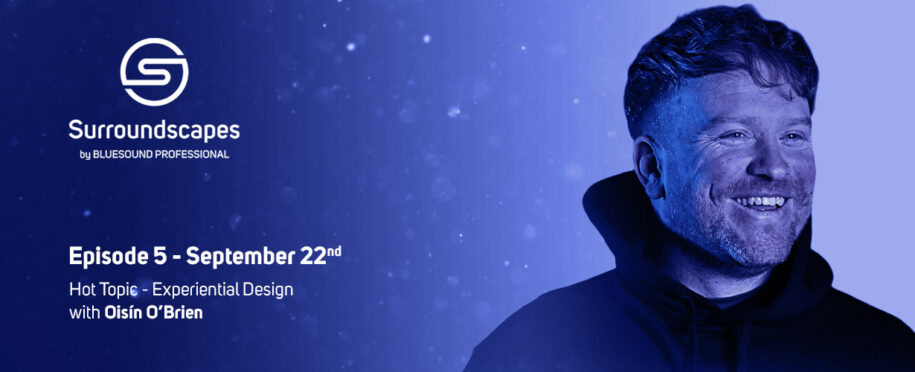
Oisin O’Brien, Founder of Visual Spectrum Studios, explores the future of immersive experiential design in Episode 5, Season 8 of the SurroundScapes Podcast
In Episode 5, Season 8 of Bluesound Professional’s SurroundScapes podcast, Oisin O’Brien, Founder of global live production and design company Visual Spectrum Studios, joins host Graeme Harrison to discuss how technology, sound, space and creative design are converging to create more complete audience experiences.
From Creative Beginnings to Technical Delivery
Oisin began his career in graphic design before moving into animation and projection mapping. “I was a really big fan of electronic artist Ammon Tobin, whose ISAM live tour brought projection mapping into mainstream live music production,” Oisin recalls. Inspired by its impact, he applied for a projection mapping role at Culture Night in Belfast around 14 years ago, despite having no previous experience.
Alongside this, Oisin was heavily involved in Belfast’s electronic music scene, creating lighting designs and building his own equipment inventory. This gradually developed into a broader production capability spanning lighting, video and immersive content, which now come together through Visual Spectrum Studios.
Where Creativity Meets Technology
A key part of Visual Spectrum Studios’ approach is bringing the creative and technical sides of production together from the outset. “One of our real strengths is that we offer a full service in terms of the production management side of things,” observes Oisin. “The studio that makes the visual content and designs the stage is also the studio that manages the full production process.”
“Because we have the production knowledge of having physically built a lot of the things that we’re asking other companies to build, we can speak with a level of fluency that allows us to deliver results that are exactly what we want.”
Graeme identifies this close relationship between creative vision and technical delivery as a key difference between experiential production and more traditional AV workflows. “It really doesn’t happen as much on our side, certainly in the installed audio industry. There’s kind of a gap between the creative community and the technology community,” says Graeme. “But really on your side of the business, that just doesn’t seem to exist. It all seems to flow into each other.”
He sees an opportunity for the AV industry to learn from this, with manufacturers engaging more directly with creative communities to understand what designers are trying to achieve, while helping creatives understand what technology can make possible. “Manufacturers need to be talking to people like you to understand what you’re dreaming about, while also showing you what their technology can do so that you can make the most of it.”
Sound as Part of the Story
For Visual Spectrum Studios, audio isn’t simply an additional layer added to visuals. “When we’re working on new media art pieces or we’re working on storytelling, audio is a key driver because essentially, it’s tied to a script. It’s tied to a concept,” explains Oisin. “And it’s a really emotional aspect of the show. It’s as much a sensory experience as it is a sonic experience.”
Bringing Technology Beyond the Stage
Indeed, for Oisin, true immersion means considering the entire space, rather than simply making the visual content bigger. “I think the audience at the back of the room should be as immersed as the audience that are right up the front,” he says. “Having the opportunity to bring the show right down into the audience with lighting, physical structures and sound, means no matter what part of the space you’re in, you’re experiencing the show.”
That thinking is also shaping Visual Spectrum Studios’ work with spatial audio. In a collaboration using L-Acoustics’ L-ISA system, the team combined spatial audio with a volumetric LED installation, with the visual elements designed to occupy the X, Y and Z axes of the space.
“I think that we take for granted the acoustics of a space,” Oisin remarks. “Having the sound travel really makes you present in the content that you’re hearing, and it changes the way that you experience it.”
“I kind of see it as a move from representative painting to abstract painting,” adds Graeme.
The Practical Challenges of Immersive Shows
As productions become more immersive, they also become more complex and expensive to tour. Oisin believes productions should design around local availability, combining readily available equipment with a smaller number of bespoke components.
“A lot of the R&D that we’ve been doing has been around where you can utilise stuff that’s readily available in its territory, but then you can maybe look at some components that are bespoke engineered,” he explains.
Build time remains a major constraint, particularly in arenas, where additional days can be prohibitively expensive. “The biggest challenge is being able to design stuff that can get built in 11 hours, but can also be immersive,” says Oisin. “The sad reality is a lot of it is grounded in the financials of whether or not you can deliver it on budget.”
Designing What Comes Next
Graeme raises the possibility of permanent immersive spaces in different cities, where audiences could experience major concerts in real time through immersive audio and visuals rather than travelling to the artist’s physical shows. Oisin sees potential in architecturally significant and heritage buildings. “Done thoughtfully, it can drive footfall and tourism while respecting the history and identity of a place, while also creating a sense of community and education.”
He also believes events are strongest when they are created specifically for their location, allowing artists to respond to the character of the space. “Having it rooted in things that are inherently tied to the identity of the place gives the people from that location ownership of it.”
That idea of creating, testing and adapting experiences for different environments is also reflected in Visual Spectrum Studios’ new Belfast space. Oisin describes it as an R&D space for developing and testing new work, both permanent and touring installations, before taking it into larger productions. “We want to look at how we can develop works that can be exported into other territories, that can be licensed to lighting festivals and other shows,” he explains.
The studio also provides a controlled environment for testing new production techniques, while Oisin is developing software to bring inventory, project and tour management into a single system.
As the boundaries between creative and technical disciplines continue to blur, immersive design is becoming less about individual technologies and more about how sound, visuals and physical space can work together. For Oisin, that means designing experiences that are not only technically achievable, but capable of making audiences feel genuinely part of the space around them.
Listen to Episode 5, Season 8 of the SurroundScapes podcast with Oisin O’Brien here.
Follow every episode of the SurroundScapes podcast and dive deeper into the world of commercial AV at surroundscapes.bluesoundprofessional.com.