
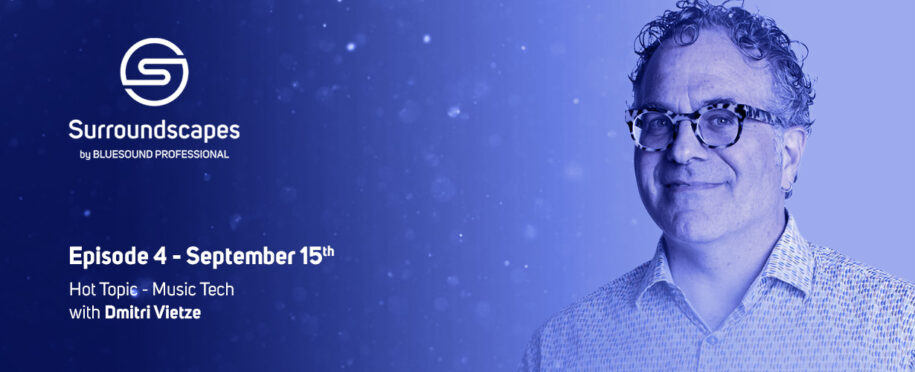
Dmitri Vietze, CEO of Rock Paper Scissors, brings a new perspective on the future of the AV industry in Episode 4, Season 8 of the SurroundScapes Podcast.
In Episode 4, Season 8 of Bluesound Professional’s SurroundScapes podcast, Dmitri Vietze, CEO of specialist tech marketing & PR company Rock Paper Scissors, joins host Graeme Harrison to discuss the changing relationship between music, technology and the AV industry, and why greater collaboration with the creative community could help shape the technology of the future.
Dmitri’s passion for music began at an early age, performing on the streets of New York before moving to Portland after college, where his interest in international artists led him into PR. His work with artists eventually brought him into music technology. After developing an automated PR platform to help independent artists reach new audiences, he began attracting interest from music technology companies looking for support with their own PR.
Founded in 1999, Rock Paper Scissors initially focused on helping international artists break into the US market before gradually shifting towards music technology. Today, the company works across PR and marketing for companies spanning music creation, streaming and more. Dmitri is also the founder of Music Tectonics, a conference bringing together people from across the music technology ecosystem, and host of the Music Tectonics podcast, which explores the people, ideas and trends shaping the future.
After the pandemic, Graeme began attending Dmitri’s Pacific Northwest music tech meetups, where he encountered a range of companies and creatives working across music and technology. For Graeme, these conversations highlighted the value of looking beyond the traditional AV industry and engaging more closely with the creative community.
“We as an industry don’t engage with the creators and say, ‘What are you dreaming of? And how can our technology help enable that?’” says Graeme.
This philosophy is at the heart of SurroundScapes, which brings perspectives from beyond the traditional AV conversation into the discussion. “What we try to do is bring people in at the edge of the industry, or really forward-thinking people, and just bring these thoughts in,” explains Graeme. “It gives people this ability once a week to hear something a little outside their normal comfort zone.”
Dmitri approaches this from the music technology side. Understanding what artists and creators want to achieve can help technology companies develop tools that support new ways of working, rather than simply adapting existing workflows. “Those are the kind of discussions that probably get you thinking about what’s the product that’s going to serve this well, and what’s the product that’s going to be agile enough to shift with how people are experiencing music?” asks Dmitri. He points to the way music consumption is changing through social media, where listeners may engage with short clips and hooks before encountering music in more traditional environments. As listening habits change, this raises questions about how technology can evolve with them.
Graeme has noticed that the role of installed audio is changing too. “Music is moving from being just an alternative to silence to intentionally curated experiences.” In retail, hospitality and other environments, businesses are increasingly considering how music can contribute to atmosphere, identity and the overall customer experience. “And this is why we now get involved in soundscaping, and that’s an interesting kind of area where you can actually intentionally curate a mood through a soundscape,” he adds.
The discussion also turns to one of the biggest developments facing the music technology industry: generative AI. For Dmitri, the question is not simply whether AI will disrupt music, but how it can contribute to growth across the wider music ecosystem. This reflects the thinking behind this year’s Music Tectonics theme, “Rising Tide: Grow the Music, Grow the Value”. “Can we think beyond tech as a disruptor, but think of it as an amplifier, as an augmenter?” asks Dmitri.
Generative AI presents its own challenges, particularly around attribution, licensing and whether human creators can compete with AI-generated music trained on their work. But Dmitri is also considering how artists might use the technology themselves, rather than simply compete against it. “I’m starting to think about how human artists can use generative AI to grow their creativity, grow their market and grow their careers and their monetization from it,” he says.
As music, technology and AV continue to converge, looking beyond the traditional boundaries of the industry could open up new ideas and opportunities. For Graeme and Dmitri, those connections could help shape what comes next.
Listen to Episode 4, Season 8 of the SurroundScapes podcast with Dmitri Vietze here.
Follow every episode of the SurroundScapes podcast and dive deeper into the world of commercial AV at surroundscapes.bluesoundprofessional.com.